Yes, GoFo tracking is legit. GoFo Express is a real, operating last-mile delivery company, and the tracking numbers it generates reflect genuine scan data from an actual logistics network, not a scam or a fake shipment generator. That short answer is true, but it does not explain why so many people ask the question, why the company’s reviews are so poor, or the one real fraud risk that does involve the GoFo name. This guide covers all three honestly. For the full tracking walkthrough, see our main GoFo tracking guide.
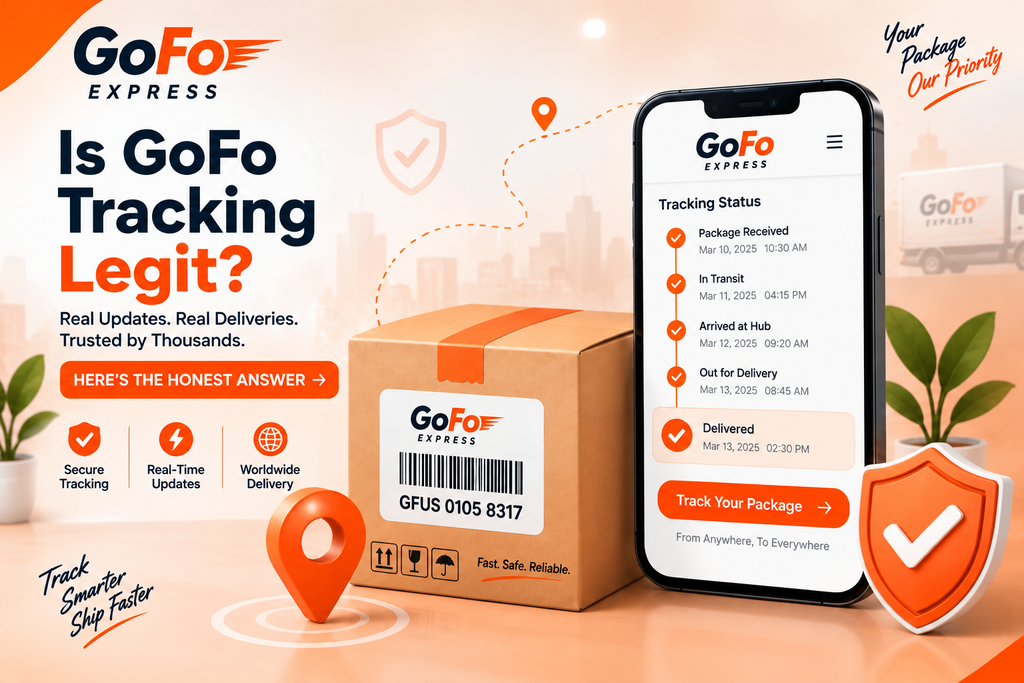
Why So Many People Ask “Is GoFo Tracking Legit?
People ask because GoFo is unfamiliar, and an unfamiliar carrier name attached to a package you barely remember ordering sets off alarm bells. Most shoppers first see the name only after buying from Shein, Temu, or TikTok Shop, when a company they have never heard of suddenly appears on their tracking.
Two other things fuel the doubt. First, GoFo has a large volume of negative reviews online, so a quick search turns up angry customers and the word “scam” used loosely. Second, there is an actual wave of phishing text messages in 2026 that impersonate GoFo, which means some people really are receiving fake GoFo messages. Sorting the real company from the scam texts is the whole point of this page, because the two are not the same thing.
What GoFo Express Actually Is
GoFo Express is a legitimate last-mile delivery company, a subsidiary of the Ebisu Group, that handles the final leg of e-commerce shipments in the United States and, through its CIRRO network, parts of Europe. It was established in 2023 and has grown quickly into a national last-mile carrier with physical sorting hubs, a public website, customer service channels, and a working tracking system.
Its business model is simple: large online marketplaces do not run their own delivery fleets, so they pay regional carriers like GoFo to deliver parcels the last few miles to your door. That is why the carrier name on your tracking rarely matches the store you bought from. The company is real and its network is real, which is the foundation of the honest answer to whether its tracking is legit.
Signs That Confirm a GoFo Tracking Number Is Genuine
If you want concrete evidence that your specific tracking number is legitimate, check for these signals:
Signs That Confirm a GoFo Tracking Number Is Genuine
A genuine GoFo tracking number has four hallmarks you can check in under a minute. If your number ticks these boxes, you are looking at a real shipment, not a fabricated one.
It Matches GoFo’s Standard Format
Real GoFo numbers follow a set pattern: a prefix such as GFUS or CIUS for U.S. parcels, followed by 13 to 14 digits, or a plain GF prefix with 12 to 14 digits. A code that matches no GoFo format may be an internal order ID or something from a phishing message rather than a carrier number.
It Returns Real Scan History
When you enter a genuine number on GoFo’s official page, it returns an actual scan history: facility arrivals, sorting, and delivery movements. A legitimate shipment produces a trail of dated events. A number that returns nothing at all, long after it should have activated, is worth a closer look.
It Matches Your Order Confirmation
A real tracking number ties back to an order you actually placed. Cross-check it against the confirmation in the retailer’s app or email. If the carrier number in your official order matches the one you are tracking, it is genuine. A number that arrives out of nowhere, with no matching order, is the classic sign of a scam text.
It Progresses Over Time
Genuine tracking moves, even if slowly. Over days you should see the status advance through the delivery stages. A number that is frozen forever, or that only ever appeared inside an unsolicited message, does not reflect a real package in GoFo’s network.
When “Fake Tracking Numbers” Are the Real Concern
The phrase “fake tracking number” points to two very different situations, and only one of them is common. Knowing which is which tells you whether to relax or to act.
GoFo Express Itself Being Fraudulent
This is not supported by the evidence. GoFo operates as a real subsidiary of an established logistics group, with physical facilities, a functioning delivery network, and a legitimate tracking system. Poor service is a fair criticism of GoFo, but the company inventing fake shipments to defraud customers is not what is happening.
A Third-Party Seller Misusing a Tracking Number
This is the more realistic version. On some marketplaces, a dishonest seller can upload a random or reused tracking number to mark an order as “shipped” without really sending it, or to delay a refund. Here the problem is the seller, not GoFo, whose system is simply displaying whatever number was entered. If a number never matches your order or never progresses, raise it with the marketplace, since buyer protection usually covers this.
When “Fake Tracking Numbers” Are Actually the Real Concern
It’s worth separating two very different situations that both get labeled “GoFo scam” online:
GoFo Express Itself Being Fraudulent
This is not supported by the evidence. GoFo operates as a real subsidiary of an established logistics group, with a functioning delivery network, physical facilities, and a legitimate tracking system.
A Third-Party Seller Misusing a Tracking Number
This is the scenario that actually causes most “is this legit” concerns across e-commerce generally, not specific to GoFo. Occasionally, disreputable sellers on marketplaces generate a shipping label or tracking number without ever handing a physical package to a carrier — a practice sometimes used to mark an order “shipped” prematurely or to satisfy a marketplace’s shipping-confirmation policy. In these rare cases, the tracking number will show a “label created” status that never progresses to an actual scan, no matter which carrier’s name is attached to it. This isn’t a flaw in GoFo’s system — it’s a seller-side issue that can theoretically happen with any carrier’s tracking number.
The distinction matters: if your GoFo tracking number shows real, progressing scan history, GoFo itself is not the problem. If a tracking number never shows any scan activity at all after a week or more, the more likely explanation is a slow seller rather than a fraudulent carrier.
Common GoFo Complaints — And What They Actually Mean
Most GoFo complaints are about service quality, not fraud, and understanding the difference keeps you from panicking over a package that is merely delayed. GoFo’s reviews are genuinely poor, so these complaints are real, but they describe a carrier with reliability problems rather than a scam.
Tracking Hasn’t Updated in Days
This usually means a normal scan gap, not a lost parcel. Last-mile networks batch their scans, and cross-border orders sit quietly in customs and international transit. A stall of a day or two, especially over a weekend, is common and typically clears on its own.
Package Marked Delivered but I Never Received It
This is GoFo’s most serious and most frequent complaint, and it is a legitimate grievance. It can happen from a misdelivery to the wrong address, a premature “delivered” scan, or theft after drop-off. If it happens to you, document it, check nearby and with neighbors, then file a claim through the retailer promptly.
Couldn’t Reach GoFo Directly
Many customers find GoFo’s support slow or hard to reach. Because GoFo works on behalf of the store, the retailer is usually the faster and more effective contact for order problems, since they hold your order details and can reship or refund.
Delivery Took Longer Than Expected
Long timelines are common, especially for cross-border orders from Shein and Temu. Much of the wait is the international and customs stages before GoFo ever receives the parcel, so slow delivery reflects the shipping route more than mishandling by GoFo.
How GoFo Compares to Other Last-Mile Carriers on Trust
On trust scores, GoFo rates below the established national carriers and in line with other budget last-mile companies that serve cross-border marketplaces. Its public review ratings are low, driven by misdelivery and support complaints rather than by fraud.
The fair context is that GoFo competes on cost, not on premium reliability. National carriers like UPS, FedEx, and USPS have decades of infrastructure and mature service standards, while newer last-mile players prioritize cheap, high-volume delivery for low-cost merchandise.
The realistic expectation: you rarely choose GoFo yourself, since the retailer picks it to keep shipping costs down. Expect affordable delivery that usually works, with a higher-than-average chance of a hiccup if something goes wrong.
Real Red Flags: When to Actually Be Concerned
The genuine fraud risk tied to the GoFo name is not the company; it is phishing messages that impersonate it. These patterns are common across the entire shipping industry, and they are the red flags actually worth watching for.
Fake Customs or Redelivery Fees
Be suspicious of any message asking you to pay a “customs release fee,” “redelivery fee,” or “unpaid shipping” through a link to receive a package. Legitimate carriers do not text you a link demanding payment to release a parcel. This is the single most common delivery scam.
Suspicious Redirects
Links in unsolicited GoFo texts often point to lookalike domains that mimic the official site, sometimes to load a fake login page or trigger a malicious download. Real GoFo tracking lives on its official domain and inside the retailer’s app, not on a random address sent by text.
Unsolicited Data Requests
Treat any message that asks for personal or payment details unrelated to a delivery you are actually expecting as a scam. A real delivery does not require you to hand over card numbers or account credentials by text or email.
Dead Tracking Numbers
A number that appears only inside an unexpected message and never returns real scan history is a warning sign. Genuine numbers tie to a real order and produce movement. A code with no order and no scans, delivered by a stranger, is not a shipment.
How GoFo Compares to Other Last-Mile Carriers on Trust
On trust scores, GoFo rates below the established national carriers and in line with other budget last-mile companies that serve cross-border marketplaces. Its public review ratings are low, driven by misdelivery and support complaints rather than by fraud.
The fair context is that GoFo competes on cost, not on premium reliability. National carriers like UPS, FedEx, and USPS have decades of infrastructure and mature service standards, while newer last-mile players prioritize cheap, high-volume delivery for low-cost merchandise. You rarely choose GoFo yourself: the retailer picks it to keep shipping costs down. So the realistic expectation is affordable delivery that usually works, with a higher-than-average chance of a hiccup if something goes wrong.
Red Flags That Would Actually Indicate a Scam
The genuine fraud risk tied to the GoFo name is not the company; it is phishing messages that impersonate it. These patterns are common across the entire shipping industry, and they are the red flags actually worth watching for.
Fake Customs or Redelivery Fees
Be suspicious of any message asking you to pay a “customs release fee,” “redelivery fee,” or “unpaid shipping” through a link to receive a package. Legitimate carriers do not text you a link demanding payment to release a parcel. This is the single most common delivery scam.
Suspicious Redirects
Links in unsolicited GoFo texts often point to lookalike domains that mimic the official site, sometimes to load a fake login page or trigger a malicious download. Real GoFo tracking lives on its official domain and inside the retailer’s app, not on a random address sent by text.
Unsolicited Data Requests
Treat any message that asks for personal or payment details unrelated to a delivery you are actually expecting as a scam. A real delivery does not require you to hand over card numbers or account credentials by text or email.
Dead Tracking Numbers
A number that appears only inside an unexpected message and never returns real scan history is a warning sign. Genuine numbers tie to a real order and produce movement. A code with no order and no scans, delivered by a stranger, is not a shipment.
How to Verify Your GoFo Shipment Is Legitimate
To verify a GoFo shipment, ignore any link you were sent and check the number yourself on the official GoFo page or, better, inside the app of the store you ordered from. Going directly to the source removes the scammer from the equation entirely.
Then confirm three things: the number matches your real order, it follows GoFo’s standard format, and it returns genuine scan history that advances over time. If all three hold, your shipment is legitimate. If a “GoFo” message arrived with no matching order, or pushes you to pay or log in through a link, do not act on it, and verify through official channels instead.
Does GoFo Express Protect Your Personal Data?
GoFo, like any carrier, receives the delivery details your retailer passes along, such as your name, address, and sometimes a phone number, which it uses to complete delivery. Handing over a shipping address to a legitimate carrier for a real order is normal and expected.
The real data risk is not the company; it is the phishing messages. Scam texts impersonating GoFo are designed to harvest information that GoFo would never ask for by text, like card numbers or login passwords. The safe rule is straightforward: a genuine delivery needs only the address you already gave at checkout, so never provide payment or account details in response to an unsolicited tracking message. For account-level privacy questions, review the privacy policy on GoFo’s official site.
Legit vs. Scam: A Quick Comparison
Real vs. Scam Tracking Checklist
The clearest way to tell a real GoFo interaction from a scam is to compare how each behaves. Legitimate tracking is something you initiate; a scam is something that arrives uninvited and pressures you.
Legitimate GoFo Tracking
- How it reaches you: You look it up in the retailer’s app or on the official site
- Order match: Ties to a real order you placed
- What it asks for: Nothing beyond your existing address
- Links: Official domain only
- Tone: Neutral status updates
Scam / Phishing Attempt
- How it reaches you: An unexpected text or email lands with a link
- Order match: No matching order exists
- What it asks for: Payment, card details, or login info
- Links: Lookalike or shortened links
- Tone: Urgency and deadlines to force a quick tap
What Legitimate GoFo Tracking Looks Like
Real tracking is quiet and self-serve. You enter a number that matches your order and see dated scan events progress toward delivery. It never demands money or credentials, and you reach it by going to the official page or app yourself.
What a Scam or Phishing Attempt Looks Like
A scam arrives unprompted, usually as a text, claiming your package is on hold and urging you to pay a small fee or update details within a short deadline through a link. The wording and amounts change, but the structure is always the same: urgency, a link, and a request for money or data.
What Real Customer Experiences Look Like
Real GoFo experiences fall into a wide range, from smooth, on-time deliveries to frustrating misdeliveries. Plenty of customers receive their packages without any issue, while others report parcels marked delivered that never arrived, or slow responses from support.
This mix is exactly what you would expect from a high-volume, low-cost carrier, and it matters for the legitimacy question because it confirms two things at once. The deliveries are real, which is why so many arrive fine, and the service is inconsistent, which is why the complaints are also real. Notably, some people who first assumed a GoFo text was a scam later received an actual package, which is a reminder that not every GoFo message is fake. The safe approach is to judge by whether the tracking matches a real order, not by the carrier’s reputation alone.
How to Report a Suspicious “GoFo” Message
If you get a suspicious GoFo message, do not tap anything in it, verify through official channels, and report it. Handling it calmly protects both your money and your data.
Go Direct
Never use the link in the message. Open the retailer’s app or type GoFo’s official address yourself to check any real shipment. Going direct means a scammer’s link never gets the chance to load.
Cross-Check
Compare any tracking number in the message against your genuine orders. If nothing matches, or you are not expecting a delivery at all, treat the message as a scam and do not engage with it.
Report as Spam
In the United States, forward the scam text to 7726, which spells SPAM, so your carrier can help block the sender, then report it to the Federal Trade Commission at reportfraud.ftc.gov and delete the message. Reporting helps shut the operation down and protects others.
Contact the Retailer
For any real order you are worried about, contact the store you bought from. They own your order and can confirm the genuine carrier and tracking number, reship, or refund. If you already entered details into a suspicious link, change that password and contact your bank right away.
Frequently Asked Questions About GoFo Tracking Legitimacy
Final Verdict: Is GoFo Tracking Legit?
GoFo tracking is legit. The company is a real last-mile carrier, its tracking numbers reflect genuine shipments, and entering your number to check status is safe. The honest caveat is that GoFo’s service reputation is weak, so set realistic expectations and keep your order confirmation in case you need to file a claim.
The one real fraud risk tied to the GoFo name is phishing: unsolicited texts that impersonate the carrier to steal money or data. Judge every message by whether it matches a real order and whether it asks you to pay or log in through a link, not by the carrier’s reputation. Verify through official channels, report scam texts, and you can use GoFo tracking with confidence. For more, see our guides on GoFo CBT tracking and GoFo Shein tracking.